Kia EV2 review: Can the Korean brand's smallest electric SUV deliver on its promise?
Kia has earned a strong reputation for building reliable, stylish and practical electric vehicles. The Korean manufacturer became the first brand from its home nation to surpass 100,000 EV sales in the UK, reaching the milestone on 11 March 2026 when the 100,000th vehicle was registered. Now it hopes to repeat its success with its smallest and most affordable electric model yet: the EV2.
The compact electric SUV enters one of the fiercest battlegrounds in the automotive world. Electric SUVs and crossovers now account for approximately 50 per cent of the total EV market in Europe, making this segment intensely competitive. The EV2 faces established European rivals including the Renault 4 E-Tech, priced from £27,195, the Skoda Epiq starting at £24,950, and the Volkswagen ID. Cross with its three motor options ranging from 114bhp to 208bhp. A growing wave of Chinese challengers adds further pressure.
Priced from £24,245 including the UK Electric Car Grant, the EV2 certainly looks competitive on paper. The grant, launched in July 2025 as a £650 million government scheme and expanded with an additional £1.3 billion in the November 2025 Autumn Budget, operates on a two-tier system. Vehicles from manufacturers with Science-Based Targets demonstrating measurable CO2 reduction goals qualify for the full £3,750, while other EVs meeting minimum sustainability criteria receive £1,500. Only cars priced at £37,000 or less before the grant are eligible.
Kia certainly has experience on its side. The brand's EV journey in the UK began in November 2014 with the Soul EV, though early sales were modest with fewer than 150 units sold by the end of 2015. The Niro EV proved far more successful, accounting for over half of Kia's 100,000 EV sales milestone with approximately 51,000 units sold over 7.5 years. By April 2026, Kia had registered 104,794 electric vehicles in the UK, demonstrating genuine market traction.
Design and positioning
Built at Kia's Žilina factory in Slovakia alongside the EV4, the EV2 started rolling off the production line in February 2026 for standard-range models, with long-range and GT-Line versions following in June. In many ways, the EV2 resembles an EV9 shrunk in the wash, borrowing the design cues and straightforward usability of Kia's successful seven-seat flagship and packaging them into a much smaller footprint.
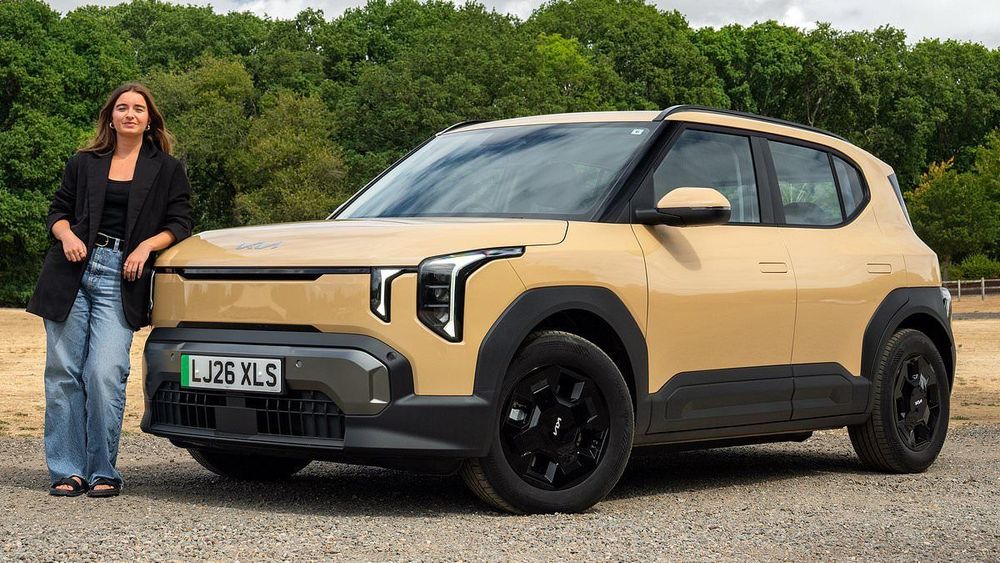
The EV2 sits below the EV3 in Kia's electric lineup and is aimed primarily at urban drivers. Models in this class typically measure around 4 metres in length, and the EV2 comes in at 4.065 metres, making it slightly shorter than the 4.3-metre EV3. Despite its compact dimensions, the car has been designed with practicality in mind, featuring reclining seats, a flat floor and a multi-level boot to maximise usable space.
By now, Kia has established a clear design language for its electric SUVs, and the EV2 follows it closely. With its upright proportions, blanked-off grille and chunky wheel arches, it features Kia's signature vertical daytime running lights, known as the 'Star Map' design, along with matching vertical tail lights at the rear. If you appreciate the current boxy SUV trend, the EV2 will likely appeal. Others may find the styling somewhat predictable.
Interior practicality and comfort
The cabin design is extremely minimalist and, in some respects, almost utilitarian. The doors feature various cut-outs and recesses, while elements such as the armrest and switchgear surround protrude from the otherwise pared-back design. There is even a cut-out behind the interior door handle that wishes occupants to 'have a nice day', part of Kia's so-called 'picnic box' design concept.
Sustainability plays a major role. Depending on trim level, the EV2 uses materials including bio-based plastics, recycled water bottles and artificial leather. The dashboard is trimmed in fabric, while the doors and centre console feature faux leather and chrome-effect accents. There remains a fair amount of plastic, though the stripped-back design helps disguise it and prevents the cabin from feeling cheap. Overall, the cabin is light, airy and relaxing, if slightly bland.
One significant issue emerged during testing: the seats proved among the most uncomfortable experienced in some time. The headrest pushed the head unusually far forward, causing neck and shoulder aches. Taller drivers may not experience the same problem, but given the EV2's compact dimensions, many people around 5ft 5in or shorter could have a similar complaint, and potentially some taller occupants too. That is a shame because the rest of the seat design is comfortable, and higher-spec models offer multiple adjustment settings. The upright design provides generous headroom.
Rear passenger space is good for a car of this size. The cabin is wide enough to accommodate three teenagers or adults for reasonable journeys, though knee room can feel a little tight, particularly behind the front passenger seat. Storage space is less impressive. The door bins are quite narrow, and only the driver's seat gets a seatback storage pocket. The fold-down centre seat includes two cupholders, but rear passengers otherwise have limited storage options.
The 362-litre boot includes underfloor storage to help keep luggage organised. Fold the rear seats down and capacity expands to 1,201 litres.
Technology and features
The EV2 features a three-screen dashboard comprising two 12.3-inch displays and a separate 5.3-inch climate control panel. Anyone familiar with Kia's infotainment systems will feel instantly at home. The setup is relatively intuitive to use, and wireless Apple CarPlay connectivity is quick and seamless.
Importantly, Kia has retained physical controls. There are steering wheel shortcuts, dedicated climate-control buttons and several haptic controls beneath the screens. The technology most appreciated for daily urban driving was the suite of parking aids, including cameras, sensors and assistance systems. The wing mirror cameras, which display blind-spot views when indicating, were especially useful.
All trims come with a strong list of comfort features, including heated front seats, a heated artificial leather steering wheel, a heated rear window, rear wiper and rear spoiler. Higher-spec models add ventilated seats, which are particularly welcome during increasingly hot summers.
Driving experience
With an electric lineup spanning passenger cars and commercial vehicles, Kia has plenty of experience building EVs that are easy to live with. The EV2 is one of those cars that requires very little acclimatisation. It feels approachable from the outset, making it an excellent everyday choice for most motorists.
Built on Kia's E-GMP (Electric Global Modular Platform) with 400-volt technology, the EV2 shares its platform architecture with other Kia EVs including the EV3, EV4, EV5, EV6 and EV9. This proven technology enables vehicle-to-grid and vehicle-to-load capabilities.
The EV2 is not sporty, nor does it attempt to be. Rather than chasing excitement, Kia has prioritised ride comfort and composure. The result is a smooth-driving SUV that feels more suburban family transport than performance machine. For a relatively small car, it coped admirably with potholes, rough surfaces and speed bumps, while motorway journeys were impressively refined.
The driving position is good, visibility is strong, and the four-stage regenerative braking system is particularly well judged. Most time was spent using one-pedal driving, which was perfect for the towns and villages encountered during testing. Despite modest power outputs of between 133bhp and 144bhp, depending on trim, performance always felt adequate. Power delivery is smooth and responsive, providing enough acceleration whenever needed.
For drivers spending most of their time in urban environments, with only the occasional longer trip, the EV2 offers everything required. One criticism concerns the Lane Keep Assist and Lane Following Assist systems, which intervene so aggressively that they can feel intrusive, particularly on narrow country roads. Worse still, they are frustrating to disable permanently despite the dedicated shortcut button on the steering wheel.
Range, charging and trims
The EV2 Air, the entry-level trim, offers a claimed range of 275 miles. The GT-Line drops slightly to 261 miles, while the flagship GT-Line S returns 257 miles. Even so, those figures should comfortably cover the weekly driving needs of most owners, while still allowing longer weekend journeys with a single charging stop in either direction.
Using a 150kW rapid charger, the battery can be replenished from 10 to 80 per cent in around 30 minutes. The same charge on a 50kW unit takes approximately 70 minutes. At home, an 11kW wallbox can recharge the battery from 10 to 100 per cent in five hours and 35 minutes.
Buyers can choose from Air, GT-Line and GT-Line S trims, all of which come generously equipped. Standard equipment includes a comprehensive safety package, the full infotainment suite and a strong selection of comfort features. Higher trims add styling enhancements, including GT-Line-specific exterior details and gloss-black trim, as well as extras such as a panoramic roof and a 15-litre front storage compartment.
Pricing starts at £24,245 for the Air. The First Edition costs £26,995, while the GT-Line is priced at £28,995 and the GT-Line S at £32,595. The mid-range GT-Line is expected to be the most popular version, which is understandable given its strong specification and sub-£30,000 price tag. Like all Kia models, the EV2 comes with the company's seven-year/100,000-mile warranty, with the high-voltage battery covered for an additional year.
Verdict
Kia has put together a very compelling package with the EV2. It is the sort of electric car that makes the transition away from petrol feel straightforward. It is pleasant to drive, thoughtfully designed, practical for family life despite its compact dimensions, and offers enough range for most driving habits. These days, buying a South Korean car is considered just as sensible a choice as opting for a Volvo, and Kia's strong reliability record should give buyers plenty of confidence.
The EV2 would not be described as exciting, either in terms of its design or the way it drives. But most buyers simply want a car that does its job well rather than one that sets pulses racing. And in that respect, the EV2 succeeds. It ticks all the boxes that matter.