Territorial control and its consequences
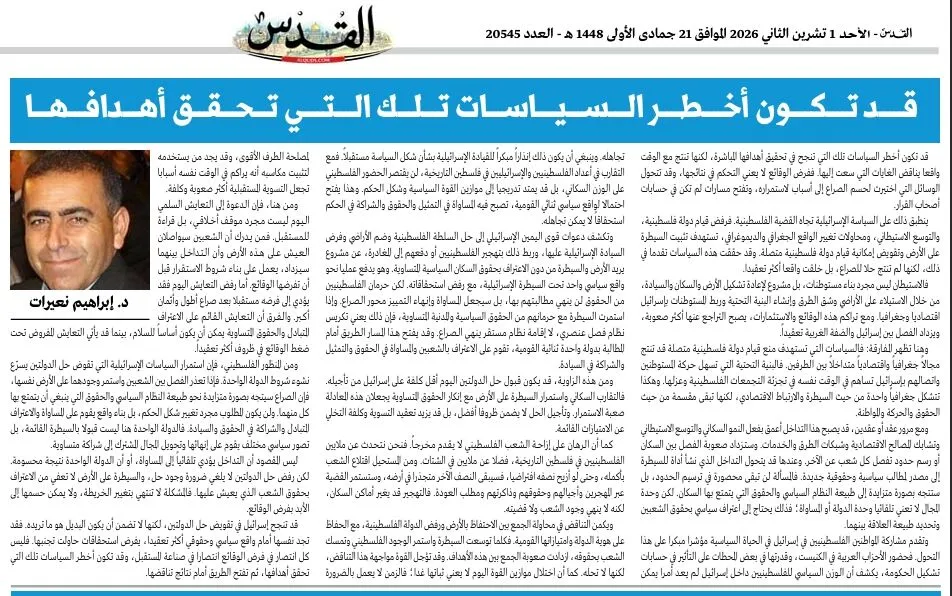
Nairat argues that settlement expansion and opposition to a Palestinian state have helped Israel consolidate its territorial control without resolving the conflict. The same policies, he writes, could make separating the two populations harder and shift the dispute toward how they are governed.
His argument centers on the connections settlements create: land seizures, roads, services and economic ties bind them to Israel, while infrastructure serving settlers divides and isolates Palestinian communities. The resulting territory is increasingly connected through Israeli control and economic activity, but its residents remain divided by their rights, citizenship and freedom of movement.
Over the next decade or two, Nairat says, population growth, further settlement construction and shared economic interests could deepen those connections. Drawing a border would then become more difficult, while demands concerning representation and rights could become more prominent. He cautions that geographic integration alone would deliver neither a single state nor equality; both peoples' rights would still require political recognition.
The scale of settlement expansion
The EU Office of the Representative for the West Bank and Gaza Strip documents the extent of expansion in its 2025 settlement report, published July 6, 2026. It records Israeli government approval of plans for 54 new settlements in the West Bank, excluding East Jerusalem, during 2025. That was an annual record and more than ten times the five approved in 2024. Another 86 outposts were erected in 2025, averaging one to two each week.
Housing plans also reached a record level. The report lists 27,941 units advanced in West Bank settlements outside East Jerusalem and 35,370 in East Jerusalem, for a combined 63,311 across the occupied Palestinian territory. It puts the settler population at more than 750,000, roughly 15 percent of the West Bank's total population, spread across 147 settlements and a rapidly expanding number of outposts, including East Jerusalem.
One project illustrates the territorial stakes. Plans for 3,401 homes in E1, east of Jerusalem near Ma'ale Adumim, received final approval in August 2025, followed by tendering that December. The EU report ranks the decision among the most strategically consequential in decades, warning that construction would divide the West Bank in two, cut it off from East Jerusalem and displace thousands of Palestinians locally.
The report also cites UN OCHA figures showing 1,828 settler attacks that caused casualties or property damage in approximately 280 West Bank communities during 2025. The total exceeded the 1,420 recorded in 2024 and 1,189 in 2023, making it the highest since monitoring began in 2006. Settlers killed nine Palestinians during the year, and 838 Palestinians were injured.
Population and parliamentary influence
Nairat points to Palestinian citizens of Israel and Arab parties in the Knesset as an indication of how population weight can translate into political influence. Their ability at times to affect government formation, he argues, should prompt Israeli leaders to consider the longer-term implications of their policies.
The October 2, 2026, parliamentary election provides recent context. According to The Indian Express, the two Arab-led parties secured a record combined 19 seats in the 120-member Knesset: 11 for the Joint List and eight for Ra'am. Prime Minister Benjamin Netanyahu's Likud-led bloc took 53 seats, while the opposition grouping led by Gadi Eisenkot won 48.
With both blocs short of the 61 seats required for a majority, the Arab parties' combined seats could provide the opposition with a route to one. The count was complete but still awaiting official certification, expected November 4, 2026.
The demographic comparison also features in Nairat's analysis. In its 2025 Nakba commemoration release, the Palestinian Central Bureau of Statistics estimated that about 7.4 million Palestinians lived in historic Palestine by mid-2025. Citing Israeli Central Bureau of Statistics estimates of about 7.4 million Israelis, it described the populations as equal.
Nairat argues that this demographic balance could gradually affect political power and the structure of government. He sees the possibility of a binational political arrangement in which demands for equal representation, rights and participation in governing become harder to disregard—not an outcome guaranteed by population figures alone.
Annexation without equal rights
For Nairat, calls from Israeli right-wing forces to dismantle the Palestinian Authority, annex territory and extend Israeli sovereignty expose a central contradiction: seeking the land while withholding equal political rights from its Palestinian inhabitants. He also links such calls to proposals to displace Palestinians or pressure them to leave.
A specific annexation proposal came from Finance Minister Bezalel Smotrich on September 3, 2025. According to The Times of Israel, he presented a map proposing annexation of 82 percent of the West Bank under the stated aim of "maximum territory and minimum Arab population." Six Palestinian population centers—Ramallah, Nablus, Jenin, Tulkarem, Jericho and Hebron—would remain as islands. Earlier that year, the Knesset had endorsed a non-binding West Bank annexation motion by 71 votes to 13.
Nairat argues that continued Israeli control without equal civil and political rights would entrench an apartheid system, not produce a durable resolution. Denying rights, in his assessment, would redirect Palestinian demands toward equality and an end to discrimination, potentially strengthening calls for a binational state with shared sovereignty and equal representation.
He rejects displacement as a way to end the conflict. Millions of Palestinians live in historic Palestine and millions more in the diaspora, he notes. Even in his hypothetical scenario in which half were displaced, the rest would remain, while those expelled and their descendants would continue to assert their rights and seek return. Moving people, he argues, would not erase either the people or their cause.
Two states, one state and the terms of coexistence
Nairat's case for accepting a two-state solution now rests partly on the costs of delay. As territorial connections deepen and populations remain on the land, he argues, a settlement may become harder to negotiate and relinquishing existing privileges more costly. Israel cannot indefinitely reconcile expanded control, rejection of Palestinian statehood and preservation of its national privileges, he contends.
Nor does today's distribution of power guarantee the same balance in the future. In Nairat's assessment, force can postpone that contradiction without resolving it, while policies intended to secure present advantages may make an eventual agreement more difficult.
He presents peaceful coexistence as a practical response to the continued presence of both peoples, as well as a moral position. A negotiated relationship grounded in mutual recognition and equal rights could support peace; coexistence reached only after prolonged conflict could come at greater cost and under more difficult conditions.
From the Palestinian perspective, he argues, policies that weaken the prospect of two states also foster conditions for pursuing one state. That alternative, as he describes it, would not legitimize existing Israeli control. It would require ending that control and establishing equality, mutual recognition and shared rights and sovereignty.
Nairat does not predict that a single state is inevitable. His warning is narrower: preventing Palestinian statehood would not eliminate the need for a political settlement, and Israel might face an alternative that demands the very rights and power-sharing its policies sought to avoid.