Trump orders return to steam catapults on future carrier despite $1.2 billion electromagnetic system contract
President Donald Trump has ordered the US Navy to abandon electromagnetic aircraft launch technology on its newest carriers in favour of returning to steam-powered catapults developed in the 1950s, a move that could cost billions of dollars and reverse years of military modernization efforts.
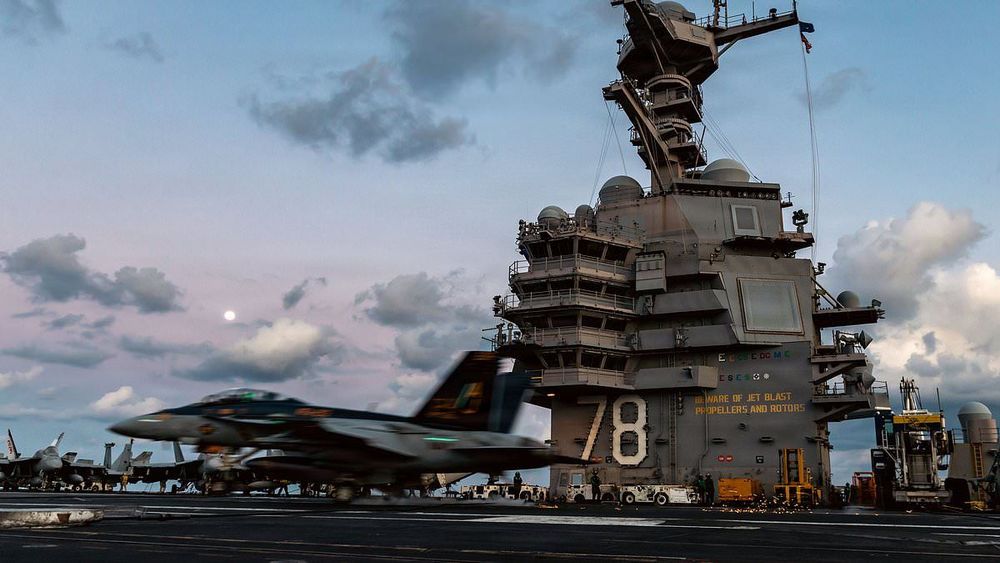
In a national security memorandum signed on Thursday, Trump directed the Pentagon to develop a plan within 60 days for installing steam catapults on the USS Doris Miller, the fourth vessel in the Ford-class carrier fleet. The directive overturns the Navy's decade-long commitment to electromagnetic aircraft launch systems (EMALS) and comes despite a $1.204 billion contract awarded to General Atomics in June 2023 for EMALS equipment on the Doris Miller, with work scheduled through 2032.
The order affects only the Doris Miller, leaving the USS Gerald R Ford, USS John F Kennedy, and USS Enterprise with their electromagnetic systems intact. However, the Navy's broader plans call for at least six Ford-class carriers, with some projections reaching ten vessels, raising questions about the future direction of the entire programme.
Reliability concerns drive presidential intervention
Trump's frustration with electromagnetic catapult technology dates to his first term, when he told Time magazine in 2017 that the digital systems were overly complex and inferior to steam. "You're going to goddamned steam," he declared at the time, criticizing what he called an unnecessarily complicated system.
The president's concerns appear grounded in documented performance issues. During testing in 2022, the USS Gerald R Ford's EMALS system achieved approximately 600 cycles between operational failures, far short of the design requirement of 4,000 cycles, according to Pentagon testing reports. The Ford was commissioned in partially-functioning form in 2017, but persistent reliability problems delayed its first full-scale deployment until 2023, more than five years after commissioning.
At a defence summit last month, Trump repeated his criticism: "Billions of dollars more they spent on electric catapults, and they're not good. They're not nearly as good, too complex."
Industry warns of massive disruption
General Atomics, the manufacturer of EMALS, told reporters that the decision warrants "careful reconsideration", noting that work on the Doris Miller's catapults and arresting gear is already halfway complete. The company warned that changing course now would "introduce significant cost, schedule, and integration risks".
The USS Enterprise and USS Doris Miller were purchased under a two-ship buy contract in January 2019, designed to achieve cost savings through serial production. Under current plans, delivery of the Doris Miller will take 15 years from the start of construction, and the vessel is already running two years behind schedule.
Redesigning a ship at this advanced stage represents a major engineering challenge. Trump's own memo acknowledged that constant design changes have been a key problem in naval shipbuilding, resulting in "cost growth, delays, and cancellations".
Technical advantages versus operational reality
EMALS was designed to accelerate aircraft more smoothly than steam catapults, putting less stress on airframes, whilst being able to launch both heavier and lighter aircraft than steam systems. The technology weighs less, requires less maintenance, and reduces the carrier's requirement for fresh water. The Ford-class carriers were designed to operate with approximately 2,600 sailors compared to roughly 3,200 on Nimitz-class ships, with the shift from steam to electrical systems like EMALS contributing significantly to this reduction.
The Navy emphasized these advantages in a February press release, stating that EMALS allowed the USS Ford to launch and recover aircraft at a higher rate than its Nimitz-class predecessors. EMALS aboard the Ford reduced the number of sailors needed to operate catapults from about a dozen to just two.
By contrast, steam catapults were developed in the 1950s and have proven exceptionally reliable over decades of service. Carriers equipped with four steam catapults have been able to use at least one of them 99.5% of the time.
Global implications and political backlash
The directive comes as other major naval powers move in the opposite direction. China commissioned its carrier Fujian on 5 November 2025 with three electromagnetic catapults, making it the first non-American carrier to skip steam technology entirely. France has also selected EMALS for its future nuclear-powered carrier replacement.
Senator Mark Kelly, an Arizona Democrat, former astronaut and test pilot with a master's degree in aeronautical engineering, delivered a scathing response. "I've launched off the front of aircraft carriers hundreds of times," Kelly wrote on social media. "Even I wouldn't suggest to the Navy how to engineer specific systems on its ships. Donald Trump should stick to what he knows best – ballrooms, bankruptcy, and bullshit."
The Wall Street Journal reported that senior Navy and industry leaders have resisted the change due to the enormous expense of removing such a complex system that was integral to the ship's design.
Broader military funding context
The controversial directive arrives as Congress weighs budget and funding bills for the Pentagon and America's ongoing Iran war. Defence Secretary Pete Hegseth estimated last month that war costs have grown to $37.5 billion, as Republicans prepared a $95 billion package to fund the military alongside other White House priorities. Hegseth described the supplemental war funding as an "urgent, necessary" injection of money, combined with Trump's proposed $1.5 trillion defence budget representing a generational investment in the military.
The House narrowly adopted both measures, but the Senate must still act when it returns in September. The timing adds further complexity to an already contentious military procurement debate, particularly as the Navy struggles with personnel shortages of approximately 20,000 unfilled posts across the fleet at the start of the year.
The USS Doris Miller, named after the first African American and enlisted sailor to have an aircraft carrier bear his name, was meant to honour Doris Miller's actions during the Pearl Harbor attack on 7 December 1941, for which he received the Navy Cross. The controversy over its propulsion systems now threatens to overshadow that historic recognition.