Vile road sign stuns Australia
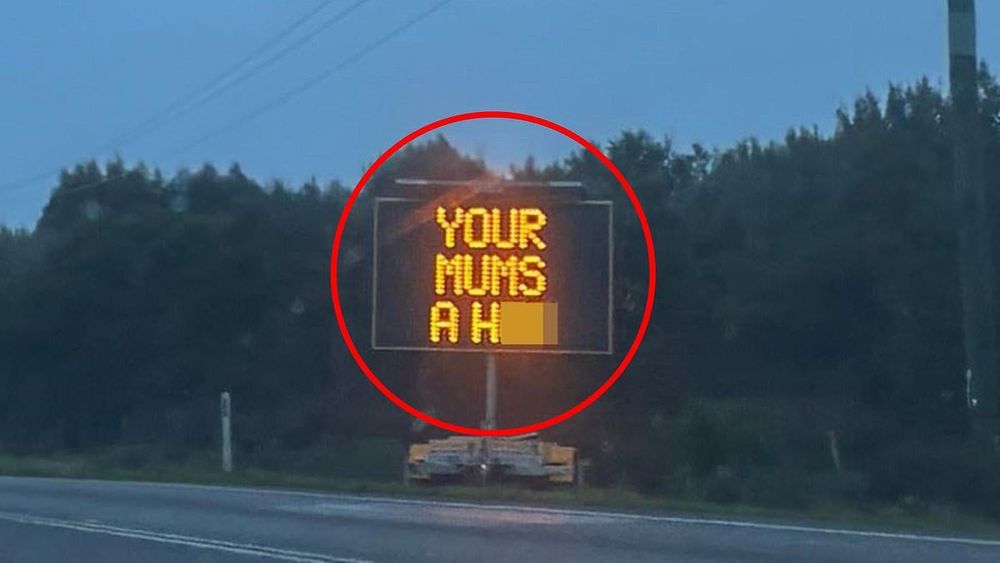
Motorists travelling along a major Tasmanian highway during Wednesday morning's commute were met with an unexpected and offensive message after vandals tampered with an electronic traffic sign.
The hacked display board appeared on the Bass Highway, part of National Highway 1 that connects the cities of Burnie, Devonport and Launceston across northern Tasmania along its 273-kilometre route, between Rocky Cape and Detention River around 7.30am.
The sign displayed the crude message: 'Your mums a h**.'
A spokesperson for Building Tasmania, the state government department responsible for roads, housing and infrastructure, confirmed the incident was an act of vandalism.
'A contractor's sign was vandalised overnight and reset to its intended message at 7.30am,' the spokesperson said, adding that any damage would be reported to Tasmania Police by the contractor.
How electronic signs are compromised
Richard Pascoe, an Adelaide-based technology consultant, explained that hacking electronic roadside signs is typically less sophisticated than many might assume.
'Someone could get inside the physical box because the lock is weak, damaged or left unlocked by a staff member,' Pascoe said. 'That would allow them access to change the message directly.'
Variable Message Signs are frequently shipped with factory-set default passwords that should be changed by operators but often remain unchanged, making unauthorised access significantly easier. Physical break-ins also remain common when locks are poorly maintained or inadvertently left unsecured.
Pascoe noted that newer signs may offer Bluetooth or local Wi-Fi connectivity, allowing authorised workers to configure them from nearby locations. However, these wireless capabilities can become vulnerabilities if not properly secured.
'It's not as simple as pointing a gadget at a secure sign and magically taking control,' he said.
Successful wireless attacks still require identifying weaknesses such as poor authentication, unsecured connections, outdated equipment or unchanged default credentials.
Part of a global pattern
The Tasmanian incident follows similar cases internationally. Recent vandalism occurred in Encinitas, California in November 2025, where multiple electronic signs were physically broken into with locks cut off. In North Carolina, hackers displayed messages reading 'Hack by Sun Hacker' on highway signs.
One of the earliest widely-publicised incidents took place in Austin, Texas in 2009, where signs were reprogrammed to warn drivers of 'NAZI ZOMBIES' and 'ZOMBIES IN AREA', raising concerns from highway safety officials about driver distraction.
Pascoe suggested such incidents have become more frequent since the 1991 film LA Story famously depicted the concept, featuring Steve Martin's character receiving romantic advice from a magical freeway sign.
Legal consequences and public reaction
Under Tasmanian law, vandalism falls under section 37 of the Police Offences Act 1935, which covers destroying or injuring property, with maximum penalties reaching fines of $3,460.
Australian social media users found the prank amusing, with some calling it 'hilarious' and 'gold'.
'Oh come on, it's funny,' one commenter wrote, whilst another added: 'Someone teach me how to do this.'
However, others criticised both the tameness of the message and the perpetrator's grammar.
'Pfft! That's lame! I've seen heaps better than that. Personally, I find more vulgarity in the bad grammar,' one person remarked.
Security experts note that Variable Message Signs have remained vulnerable to both physical and remote cyber attacks for over a decade, with weaknesses including inadequate physical locks, unchanged default passwords and unsecured wireless connections continuing to enable such breaches.